
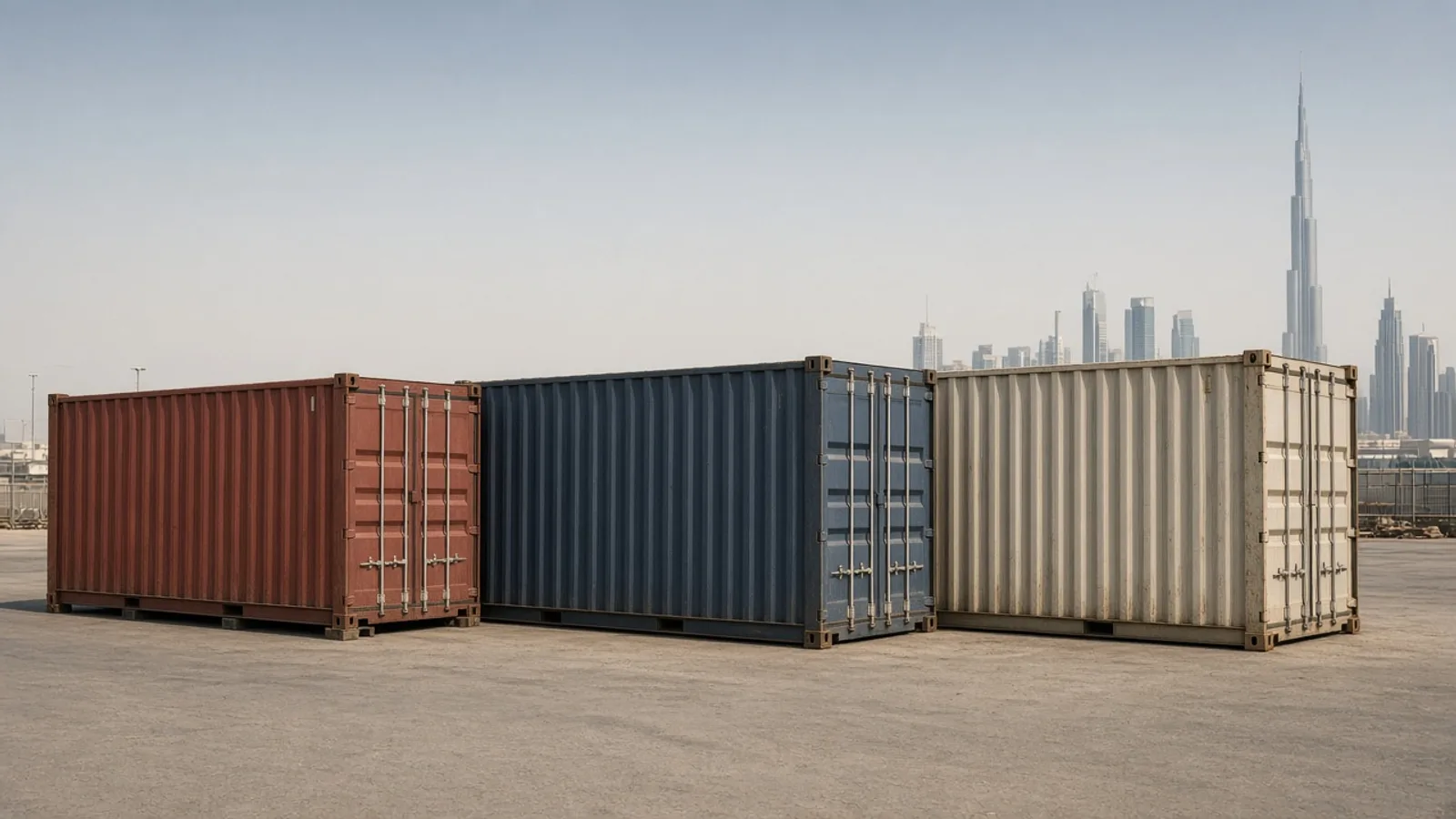

Understanding shipping container sizes UAE businesses commonly request helps you avoid paying for unusable space or discovering that a unit cannot enter your site. The main dry container options are 20ft standard, 40ft standard and 40ft high cube. Each has the same nominal external width, but they differ in length, height, capacity, handling needs and suitability for different cargo.
This shipping container sizes UAE guide gives practical planning dimensions and explains what to confirm with your supplier.
Shipping container sizes UAE buyers should compare
Container names use nominal imperial lengths, while UAE project drawings and site measurements often use metres. The following figures are approximate. Exact dimensions, door openings, weights and ratings can vary slightly by manufacturer and unit.
| Container | Approximate external dimensions | Approximate internal dimensions | Approximate internal volume |
|---|---|---|---|
| 20ft standard | 6.06m x 2.44m x 2.59m | 5.90m x 2.35m x 2.39m | 33 cubic metres |
| 40ft standard | 12.19m x 2.44m x 2.59m | 12.03m x 2.35m x 2.39m | 67 cubic metres |
| 40ft high cube | 12.19m x 2.44m x 2.90m | 12.03m x 2.35m x 2.69m | 76 cubic metres |
Use these numbers for initial comparison only. Request the specification and data plate details for the container being offered. The International Organization for Standardization publishes ISO freight container dimension and rating standards used across the industry.
20ft standard containers
A 20ft shipping container is a familiar option for construction tools, spare parts, retail stock, records and household goods. Its footprint suits many yards and project sites, and the shorter interior can make stock near the rear easier to reach.
Volume is only one limit. Heavy products can reach the permitted transport or container weight before the space is full. If you plan to store metal, stone, liquids, machinery or other dense goods, provide an estimated total cargo weight. The floor loading and distribution also need consideration.
For regular access, allow space for an aisle and door operation. Shelving can improve organisation but reduces clear width. If the container will sit outdoors, discuss ventilation, moisture management, security and the condition appropriate for the goods.
40ft standard containers
A 40ft shipping container gives significantly more floor area and is well suited to long items or bulky, lower-density inventory. It can support zones for different departments, project phases or stock categories. For businesses with sufficient land, one large unit may be easier to manage than stock spread between smaller units.
The trade-off is access. A 40ft unit requires a longer prepared base, a larger delivery vehicle arrangement and more room for manoeuvring and lifting. Measure the complete approach, not just the final footprint. Gates, corners, parked vehicles, street furniture, cables and building canopies can all affect placement.
A 40ft container is not automatically the best value because it offers more volume. If half the space remains unused, or staff cannot retrieve items efficiently, a smaller unit may be the better commercial choice.
40ft high cube containers
A 40ft high cube container is approximately 30cm taller externally than a standard unit. The extra internal height is useful for tall cargo, higher shelving, certain equipment and conversion projects where insulation or ceiling services reduce headroom.
High cube does not mean a higher maximum payload in every case. Ratings and tare weights must be checked for the specific container. The greater external height can also affect transport under gates, roofs or overhead services. Make sure the route and placement area have suitable vertical clearance.
Other container types and dimensions
Standard dry units cover many requirements, but specialist applications need specialist equipment. A reefer container includes refrigeration machinery and insulated walls, so its internal dimensions and payload differ from a dry container of the same nominal length. Power supply, airflow and drainage must be planned.
Open top, flat rack and side-opening configurations may suit unusual loading methods or oversized cargo, subject to availability and transport requirements. Converted office containers and cafe containers lose some internal space to lining, insulation, partitions, equipment and services. Ask for finished internal dimensions when planning furniture or machinery.
How to calculate the space you really need
Create a simple inventory with the length, width, height and weight of major items. For cartons or pallets, record quantity and whether stacking is permitted. Then draw the internal container footprint and arrange the items with realistic gaps.
- Allow an aisle if people need regular access.
- Keep ventilation paths clear where required.
- Leave room around equipment that needs maintenance.
- Check that each item passes through the door opening.
- Consider how a forklift or pallet trolley will approach.
- Plan weight distribution rather than concentrating heavy goods in one area.
For changing inventory, include sensible spare capacity without oversizing excessively. If separation is important, two smaller containers may be more useful than one larger unit. Compare the full cost, including prepared bases, delivery and operation.
UAE delivery and site checks
Container delivery requirements vary between industrial zones, construction sites, warehouses and residential locations. Confirm who controls the land and whether the site requires access approval, lifting documentation or a scheduled delivery window. For customs and trade procedures, use official information from Dubai Customs.
Measure the gate, route, corners, working area and overhead clearance. Share photos from the public road through to the exact placement position. The surface should be level, stable and suitable for the loaded weight. Proper support at the corner castings helps maintain alignment and door operation.
Read the container delivery guidance for Dubai before ordering. Customers outside Dubai can also review TAT Containers’ UAE locations.
Condition, use and compliance questions
Tell the supplier whether the container is for static storage, transport, export or conversion. A unit suitable for on-site storage is not automatically suitable for sea freight. Export plans should be checked against current shipping line, route, customs and certification requirements.
Compare used and new containers based on function and appearance. Ask about doors, seals, floor, corrosion, repairs and weather resistance. For food, chemicals, dangerous goods or occupied conversions, obtain advice specific to the product and authority requirements.
Information to include in your enquiry
Send the intended use, cargo description, dimensions, estimated weight, preferred size, required condition and site address. Add access measurements, photos and any modifications. If you are uncertain, the inventory and site details are more useful than guessing a container size. Contact TAT Containers to discuss a suitable configuration and delivery plan.
Frequently Asked Questions
What is the most common shipping container width?
Standard 20ft, 40ft and 40ft high cube dry containers are approximately 2.44m wide externally. Internal width and door opening width are smaller, so confirm both for your goods.
How much taller is a high cube container?
A high cube is approximately 30cm taller externally than a standard container. The useful internal height gain is similar, but exact dimensions vary by unit.
Can all shipping containers be used for export?
No. Suitability depends on condition, certification, the shipping line, route and current requirements. Tell the supplier about export use before purchasing or hiring.
Should I choose one 40ft or two 20ft containers?
One 40ft provides continuous space, while two 20ft units can separate inventory and may offer more flexible access. Compare delivery access, foundations, workflow and total cost.
Do modifications change internal dimensions?
Yes. Insulation, wall lining, floors, partitions, electrical services and equipment all reduce usable space. Request finished dimensions for a converted unit.